Around the show
Taormina after dark: a walk around the show
How to fit a Taormina walk around an opera evening: Corso Umberto, Piazza IX Aprile, the cathedral square and what each was built for.
Reserve a seat for the opera ↗A town built for walking
Taormina has been a tourist destination since the 19th century, and it was known for well-off visitors from northern Europe after Italian unification. It sits on a cliff overlooking the Ionian Sea, with old churches, bars, restaurants and antique shops. The old centre is compact, so an opera evening fits easily between a late afternoon wander and dinner. Leave extra time for the slopes and the steps, and keep a layer for the evening.
Corso Umberto
Corso Umberto is the main street of the old town and the line along which most sights lie. Walk it in the late afternoon to see the town in the light before the evening. Piazza IX Aprile sits at its centre, and the cathedral square is a short way down the street. You do not need a plan: the street leads you from one square to the next, and every side lane has a view.
Piazza IX Aprile
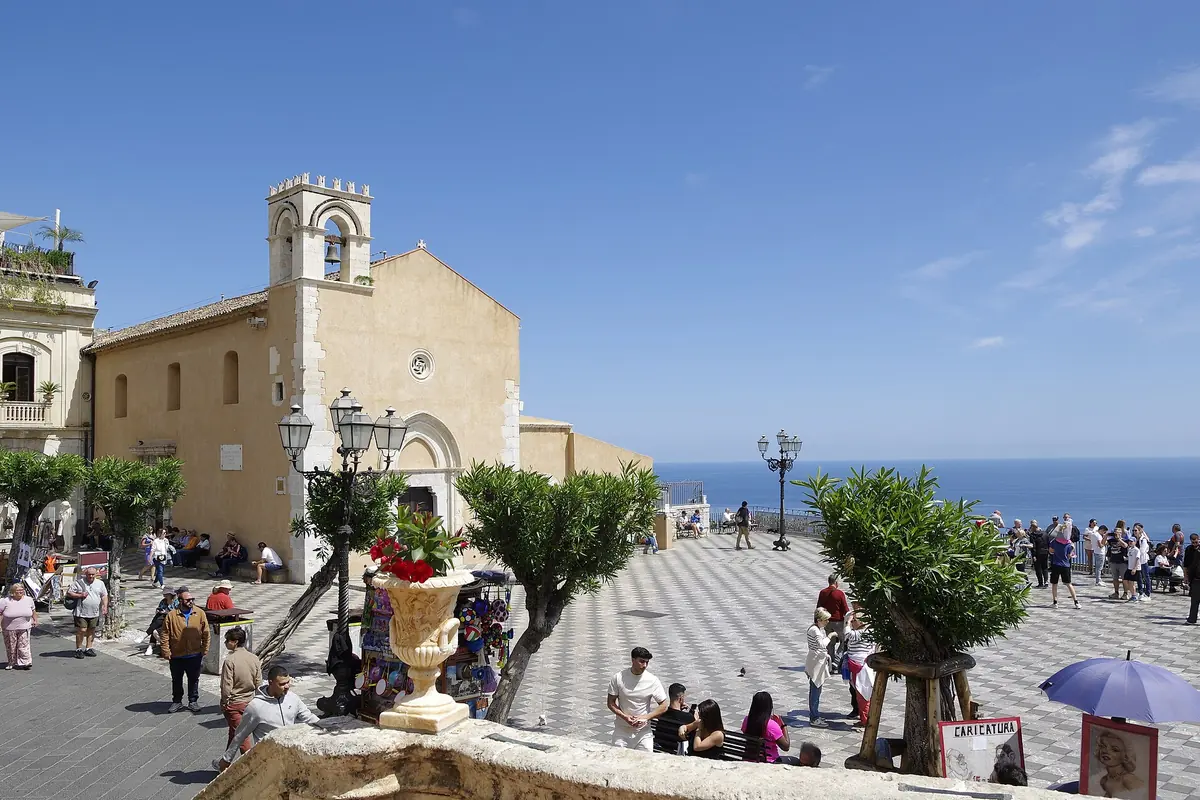
The square is known for its view of the Ionian Sea and Mount Etna. It was named for 9 April 1860, when a mass in the cathedral was interrupted to announce that Garibaldi had landed at Marsala to begin the conquest of Sicily that made it part of Italy. Cafés line it, and it is a good place for a drink before the show. Its chequered stone floor and its lamps make the square an easy place to meet before the show, whether you sit with a drink or simply wait for the people you came with.
The cathedral square
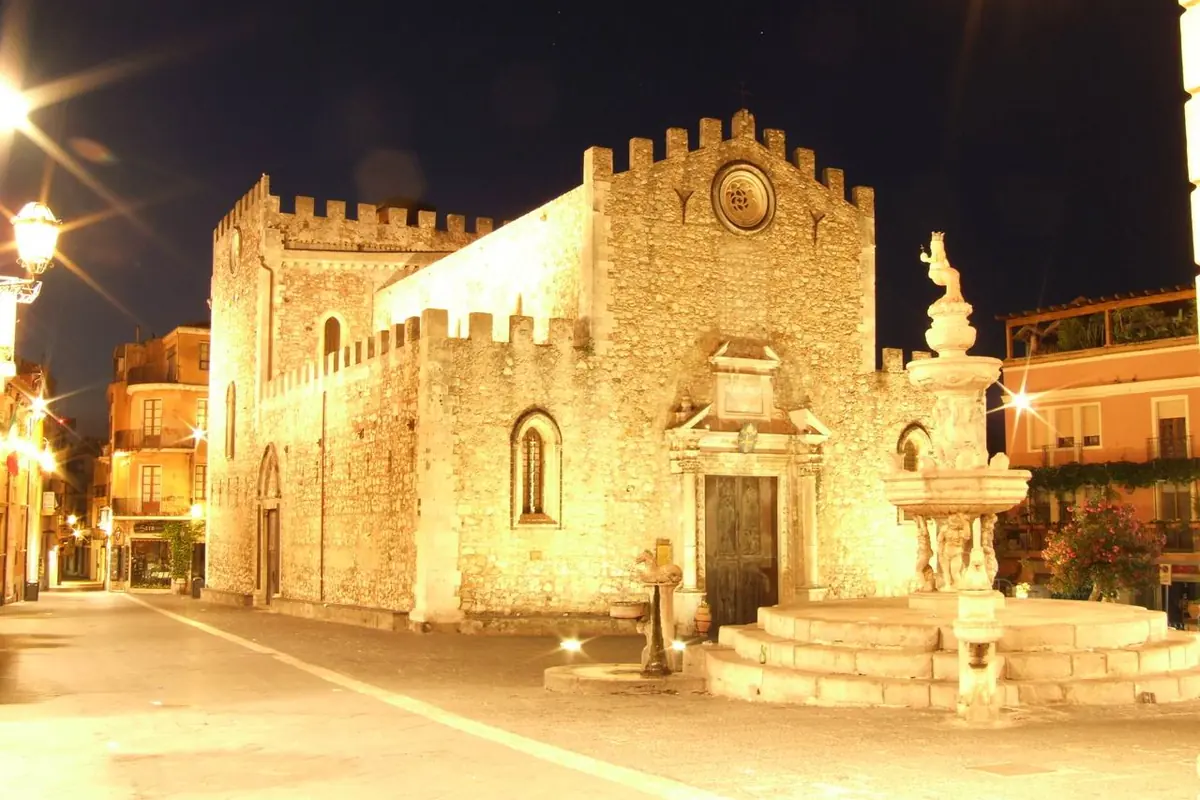
The first construction of Taormina's cathedral dates to the 13th century, on the ruins of a church dedicated to St Nicholas of Bari, and it was rebuilt in the 15th, 16th and 18th centuries. In front of it stands a Baroque fountain built in 1635, sometimes called the four fountains, topped by a figure that is half human and half horse, the emblem of the town. The square is lit at night.
Before and after the opera
The opera lasts about 1.5 hours, which leaves the rest of the evening open. Eat first if you prefer a lighter show, or afterwards if you want to talk it over. The ticket includes only a glass of Prosecco and water, so dinner is your own plan. Whichever you choose, book a table ahead in the season, and allow time to walk to Via Fontana Vecchia, since the old streets slow every walk. See the guide to the theatre itself for the address and the ways to reach the town.
Read next: Teatro Nazarena Taormina: how to get there
Mount Etna and the coast
Taormina is approximately a 45-minute drive from Mount Etna, according to Wikipedia, which calls it one of the tallest active volcanoes in Europe. Just south of Taormina is the Isola Bella nature reserve, and further south, beside a bay, the resort town of Giardini Naxos. The beaches on the Ionian Sea are reached by an aerial tramway built in 1992 or by road. These are daytime plans, which leave the evening free for the opera.
Palazzo Corvaja and the castle
Other sights on the old town's list include the Palazzo Corvaja, dated to the 12th to 14th centuries, and the Saracen Castle, built by the Arabs on the rock of Monte Tauro high above the town. The castle is reached by a staircase and sits roughly 400 metres up, according to a tourism site, so it is a daytime climb and not an evening stroll. A walk on the flatter streets suits the hour before a show.
The town's long story
Taormina's history dates to before Ancient Greece established its first colony on Sicily in 734 BCE. The Greek name of the city was Tauromenion, later Latinised to Tauromenium. After the fall of the Western Roman Empire it remained one of the island's more important towns, and it followed the history of Sicily in being ruled by successive foreign monarchs. Walking its streets in the evening means walking over a very long history.
Sources